
The Science of Hybrid Polyurea
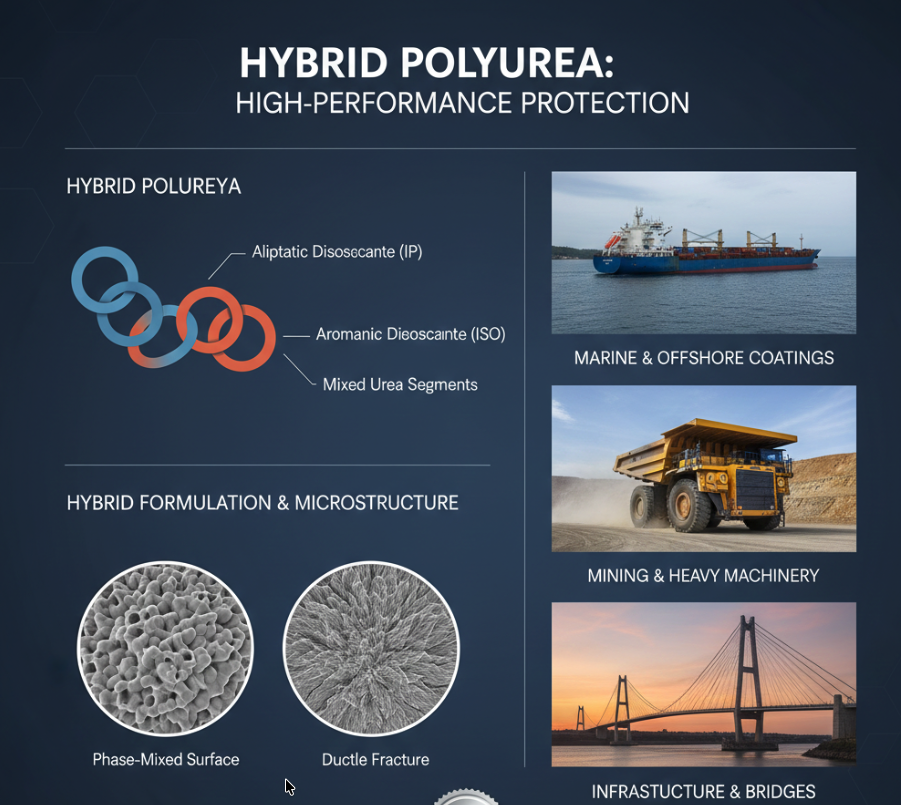
Recent research has successfully developed a high-performance polyurea by blending aliphatic (IP) and aromatic (ISO) diisocyanates. The study identified that a 37.5:62.5 weight ratio creates a material with an optimal balance of strength and flexibility.
Key performance metrics include:
Tensile Strength: 47.80 MPa
Elongation: 500%
Hardness: 95 HA
Durability: Proven corrosion resistance after 28 days of continuous salt spray exposure.
By precisely controlling the “mixed urea segments,” this formulation creates a coating that dynamically responds to stress, reforming internal bonds to maintain integrity under harsh conditions.
High-Performance Polyurea: Bridging the Gap Between Strength and Flexibility
Polyurea is a leading solution in the protective coatings industry, but the quest for superior performance has led to a new breakthrough: the synergy of hybrid aliphatic and aromatic diisocyanates. This advancement is set to redefine how industrial infrastructure is protected from the elements.
The Engineering Behind “Hybrid” Formulations
Historically, engineers faced a trade-off between the UV stability of aliphatic coatings and the high mechanical strength of aromatic ones. By combining Isophorone Diisocyanate (IP) and Polycarbodiimide-modified Diphenylmethane diisocyanate (ISO), a “best of both worlds” material has been engineered.
The 37.5:62.5 (IP:ISO) ratio creates a unique molecular architecture. Unlike standard coatings that can be brittle under extreme pressure, this hybrid version features a ductile fracture mechanism. This allows the material to stretch and deform to absorb energy rather than cracking. Analysis reveals a unique stress relaxation pattern where hydrogen bonds reform during chain alignment, effectively allowing the material to manage internal loads.
Industrial and Commercial Applications
With a combination of extreme durability and 500% elongation, this hybrid polyurea is designed for environments where material failure is not an option:
Marine & Offshore Infrastructure: Having passed 28-day salt spray tests with no signs of failure, this coating serves as a robust shield for ship hulls, offshore oil rigs, and coastal bridges.
Heavy Mining Equipment: The 95 HA hardness ensures that chutes, hoppers, and vibrating screens can withstand the constant abrasion and impact of rock and ore processing.
Automotive & Transportation: From truck bed liners to chassis protection, the material’s ability to stretch ensures it remains intact even when subjected to high-velocity road debris.
Energy & Utilities: Its chemical resistance and high tensile strength make it a reliable barrier for primary and secondary containment, such as chemical storage tanks and wastewater facilities.
Conclusion
By fine-tuning the ratio of aliphatic and aromatic components, researchers have developed a coating that is as smart as it is tough. This hybrid approach ensures that metal surfaces remain corrosion-free and structurally sound, even in the most punishing industrial environments
reference :
Hybrid aliphatic and aromatic diisocyanates forming mixed urea segments for high-performance polyurea Khanisya Palaniandy a , Sheik Ambarine Banon Auckloo a , Giuseppe Cavallaro b , Giuseppe Lazzara b , Eng-Seng Chan c , Pooria Pasbakhsh a,* a Department of Mechanical Engineering, School of Engineering, Monash University Malaysia, Jalan Lagoon Selatan, Bandar Sunway, 47500 Subang Jaya, Malaysia b Department of Physics and Chemistry “E. Segr`e”, University of Palermo, Viale delle Scienze, pad. 17, Palermo 90128, Italy c Department of Chemical Engineering, School of Engineering, Monash University Malaysia, Jalan Lagoon Selatan, Bandar Sunway, 47500 Subang Jaya, Malaysia