
Nonporous Transparent Electrospun Polyurea Nanocomposite Films For Anticorrosion Coatings
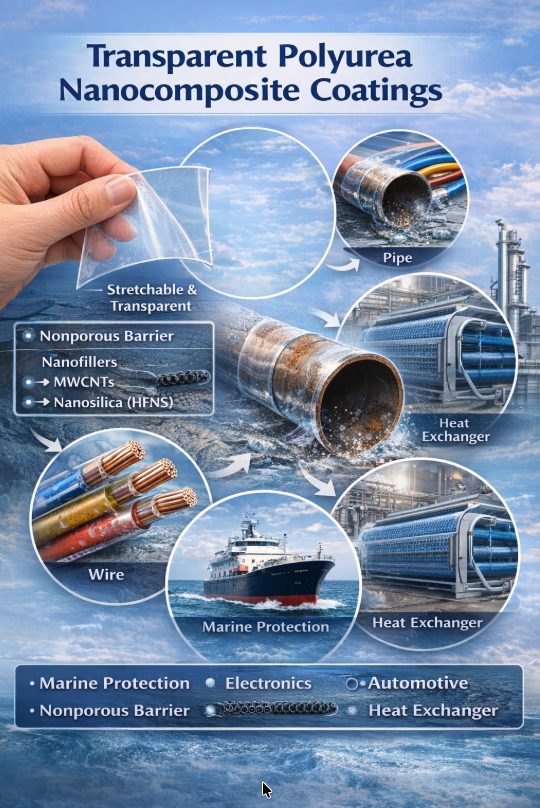
Corrosion remains one of the most persistent and costly challenges facing industrial infrastructure globally. In Australia alone, the annual cost of corrosion is estimated at over $30 billion, impacting sectors from mining and resources to maritime and defence.
The Research Challenge
Traditional anticorrosion coatings face a fundamental trade-off between barrier performance and optical transparency. Opaque coatings may offer excellent protection but obscure inspection of the underlying substrate. Transparent coatings, meanwhile, often sacrifice barrier density for clarity.
Our research set out to challenge this compromise through the development of nonporous transparent polyurea films reinforced with nano-scale fillers via electrospinning — a process that produces fibres at the nanometre scale with exceptional control over porosity and morphology.
Key Findings
The electrospun nanocomposite approach yielded films with:
- Optical transmittance above 85% in the visible spectrum
- Water vapour transmission rates reduced by up to 70% versus unfilled films
- Corrosion inhibition performance comparable to commercial epoxy primers
- Flexibility and elongation compatible with dynamic substrates
Industrial Implications
These results suggest viable pathways for transparent anticorrosion protection in applications where visual inspection of coated components is required — including structural glass, sensor windows, and precision optical systems exposed to aggressive environments.