
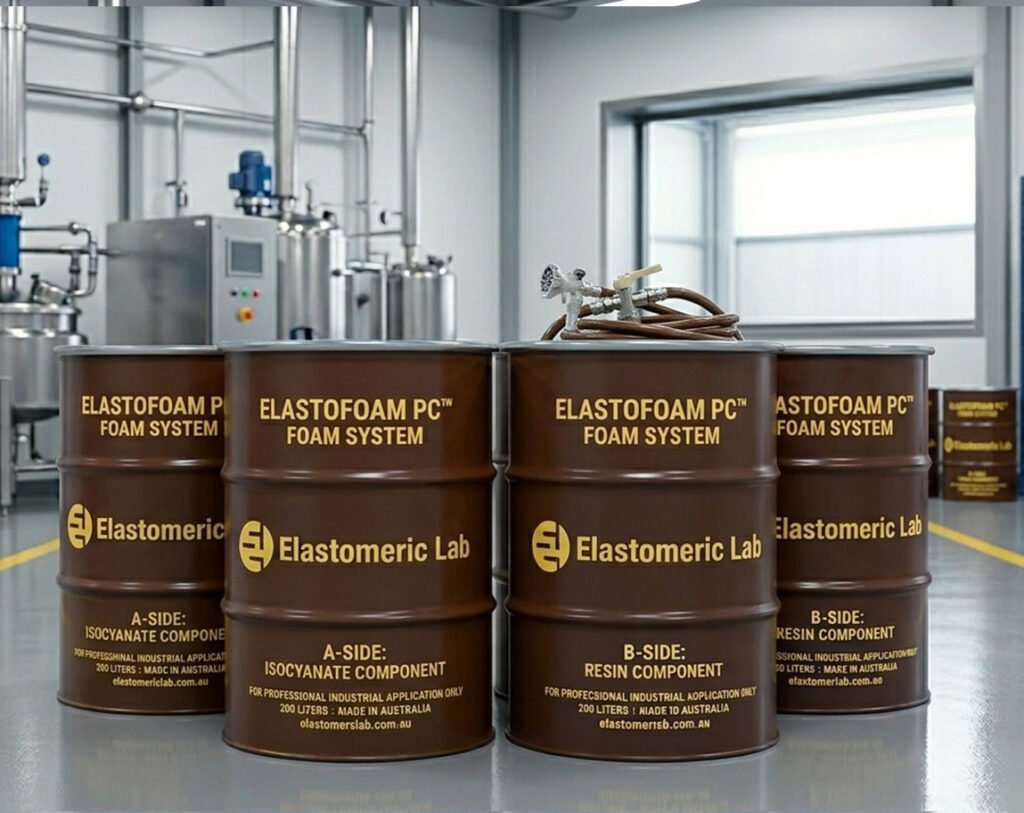
Unbiased Foam Specification
Off-the-shelf foams often force trade-offs between density, cure time, closed-cell content, and dimensional stability. We eliminate that compromise.
Formula Neutrality
We select systems based strictly on performance data, not supplier targets.
Tailored Reaction Kinetics
Cream, gel, and tack-free times are tuned for your processing method — pour, spray, or moulding.
Targeted Physicals
Optimise density vs. mechanical strength to minimise material usage while meeting engineering specs.
Australian
An Australian company delivering world-class technology with a global perspective.
Foam Technology Comparison Matrix
Selecting the proper foam technology requires balancing density, cell morphology, compressive performance, and thermal resistance.
| Technology | Density Range | Cell Structure | Primary Function | Strength | Ideal Profile |
|---|---|---|---|---|---|
| Spray Polyurethane Foam | 10 – 60 kg/m³ | Open or Closed | Thermal Insulation | Low to Moderate | Building envelopes, cold storage, roofing insulation |
| Rigid Structural Foam | 60 – 500+ kg/m³ | High Closed (>90%) | Load Bearing & Void Fill | High to Extreme | Core materials, void filling, pipeline supports |
| Flexible & Microcellular | 30 – 250 kg/m³ | Open or Microcellular | Shock Absorption | Dynamic / Resilient | Seating, impact protection, gasketing |
| Elastomeric Moulded | 150 – 800 kg/m³ | Integral Skin | Wear & Environmental | High Toughness | Handles, marine floats, protective trims |
Foam Chemistry & Technology Breakdown
Technical detail on each foam category we formulate, test, and specify.
Spray Polyurethane Foam (SPF)
Thermal InsulationKey Strengths: High thermal efficiency (R-value), continuous air sealing, rapid expansion and gelation.
Lab Evaluation: Thermal conductivity, dimensional stability at elevated temperatures, closed-cell percentage via gas pycnometry.
Best Suited For: Industrial tank insulation, commercial building envelopes, cold storage facilities, and pipe insulation.
Rigid Structural & Injection Foams
High StrengthKey Strengths: High compressive strength-to-weight ratio, extremely low water absorption, void-filling capacity.
Lab Evaluation: Compressive strength testing, water absorption immersion, closed-cell content, dimensional change under load.
Best Suited For: Sub-grade void filling, pipeline supports, marine buoyancy, and structural core materials.
Flexible & Microcellular Foams
Shock AbsorptionKey Strengths: Dynamic resilience, energy absorption, compression set resistance over repeated cycles.
Lab Evaluation: IFD (Indentation Force Deflection), compression set, resilience rebound, tear propagation.
Best Suited For: Seating components, impact protection systems, gasketing, and vibration damping.
Elastomeric Moulded Foam
Integral SkinKey Strengths: Tough outer skin with flexible cellular core, excellent environmental resistance and aesthetics.
Lab Evaluation: Integral skin thickness, flex fatigue, UV stability, and adhesion to in-mould coatings.
Best Suited For: Handles, protective trims, marine floats, and structural covers requiring durability and finish.