
The Unbiased Specification Advantage
Most coating manufacturers sell what they make. We specify what your project actually needs.
Brand-Neutral Chemistry
We evaluate chemistry purely on performance data, not supplier relationships.
Custom Prototyping
We modify formulations in our lab to match your specific application method and site constraints.
Risk Reduction
Validate adhesion, flexibility, and chemical resistance before full-scale application.
Australian
An Australian company delivering world-class technology with a global perspective.
Technology Comparison Matrix
Selecting the right protective coating requires balancing mechanical properties, cure speed, UV stability, and environmental conditions.
| Technology | Cure Speed | Flexibility | Chemical Resistance | UV Stability | Best For |
|---|---|---|---|---|---|
| Polyurea | Seconds–Minutes | Exceptional (>300%) | Moderate–High | High (Aliphatic) | Primary containment, waterproofing, high-impact protection |
| Polyurethane | Fast–Moderate | High (100–300%) | Good | Very High | Weather exposure, flexible substrates, trafficable membranes |
| Epoxy | Slow–Moderate | Low (<15%) | Exceptional | Low (chalks) | Structural steel, secondary containment, concrete primers |
| Polyaspartic | 15–40 Min | Moderate–High | High | Superior | Fast topcoats, UV exposure, high-abrasion floors |
Coating Chemistry Breakdown
A technical deep-dive into each technology category we evaluate and specify.
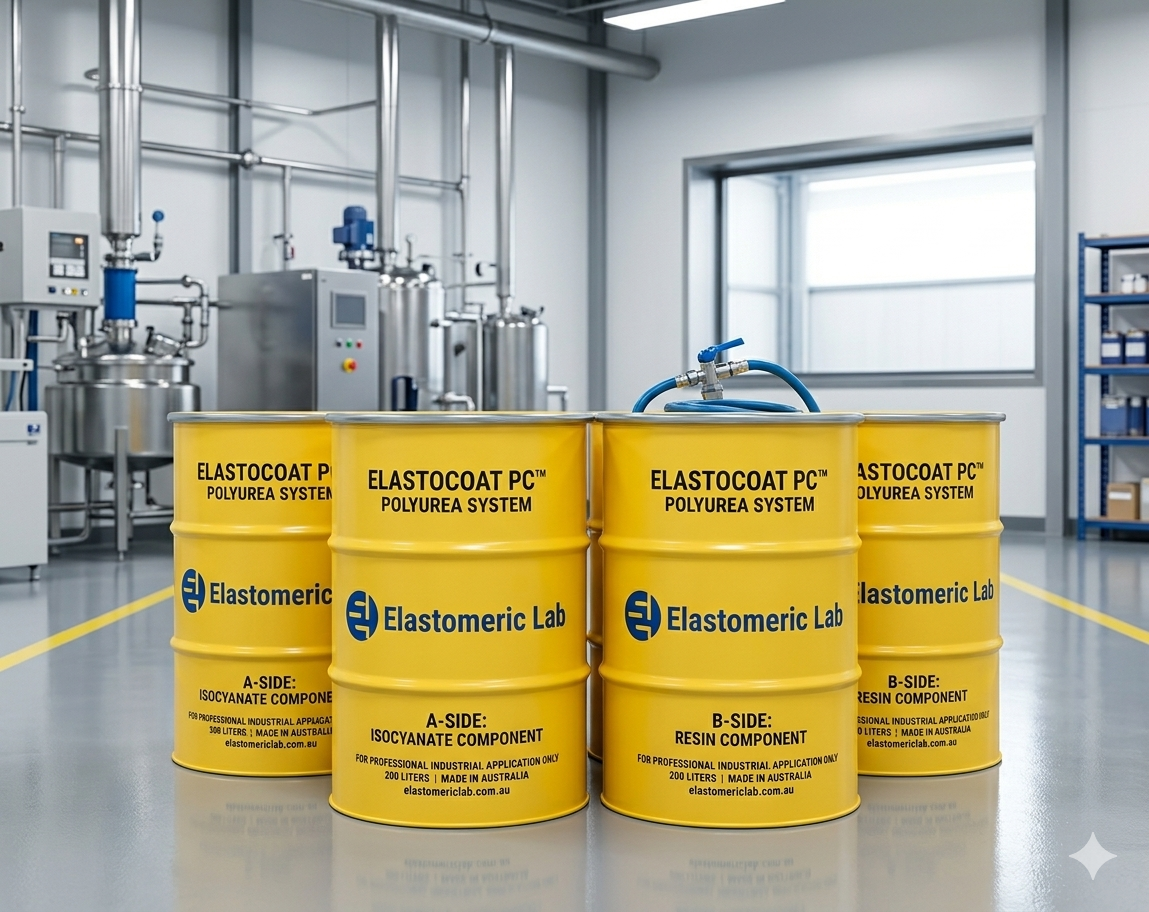
Polyurea Coatings
Rapid CureKey Strengths: Seamless membrane formation, extreme impact resistance, rapid return-to-service (often under 1 hour).
Lab Evaluation: Shore hardness testing, tear strength, crack-bridging capability at sub-zero temperatures.
Best Suited For: Tank linings, wastewater infrastructure, pipe coatings, and heavy mining asset protection.
Polyurethane Coatings
High FlexibilityKey Strengths: High abrasion tolerance, superior flexibility over movement joints, stable under dynamic mechanical stress.
Lab Evaluation: Tensile strength vs. elongation curve analysis, dynamic fatigue resistance, UV weathering cycles.
Best Suited For: Exposed structural steel, trafficable membranes, flexible substrates in dynamic environments.
Epoxy Coatings
Chemical ResistanceKey Strengths: Exceptional solvent and acid resistance, high compressive strength, outstanding substrate adhesion.
Lab Evaluation: Chemical immersion panels, cross-cut adhesion testing, and holiday detection on complex geometries.
Best Suited For: Secondary containment, structural steel primer systems, and heavy industrial floor coatings.
Polyaspartic Coatings
UV StableKey Strengths: Superior UV stability, fast turnaround, high abrasion resistance with a non-yellowing finish.
Lab Evaluation: Accelerated weathering (QUV), colour stability, and hardness development at varying temperatures.
Best Suited For: Fast-turnaround topcoats, direct UV exposure, high-abrasion floors requiring aesthetic finish.